
Last updated September 10, 2026
Full 25-point door and opener safety check with every visit - springs, cables, rollers, tracks, and your LiftMaster or Chamberlain opener included
You get a price before we start. It does not change when the truck arrives.
 Before
 After
After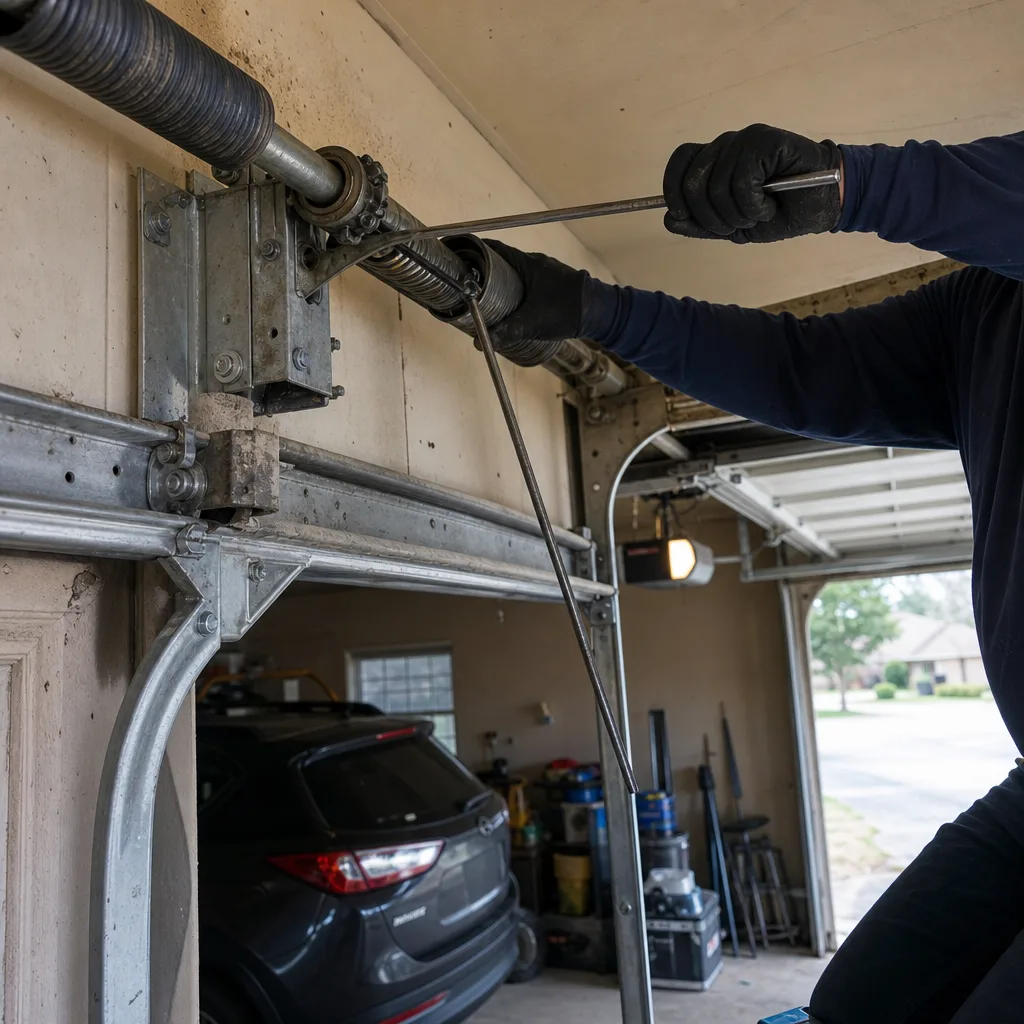 Before
 After
After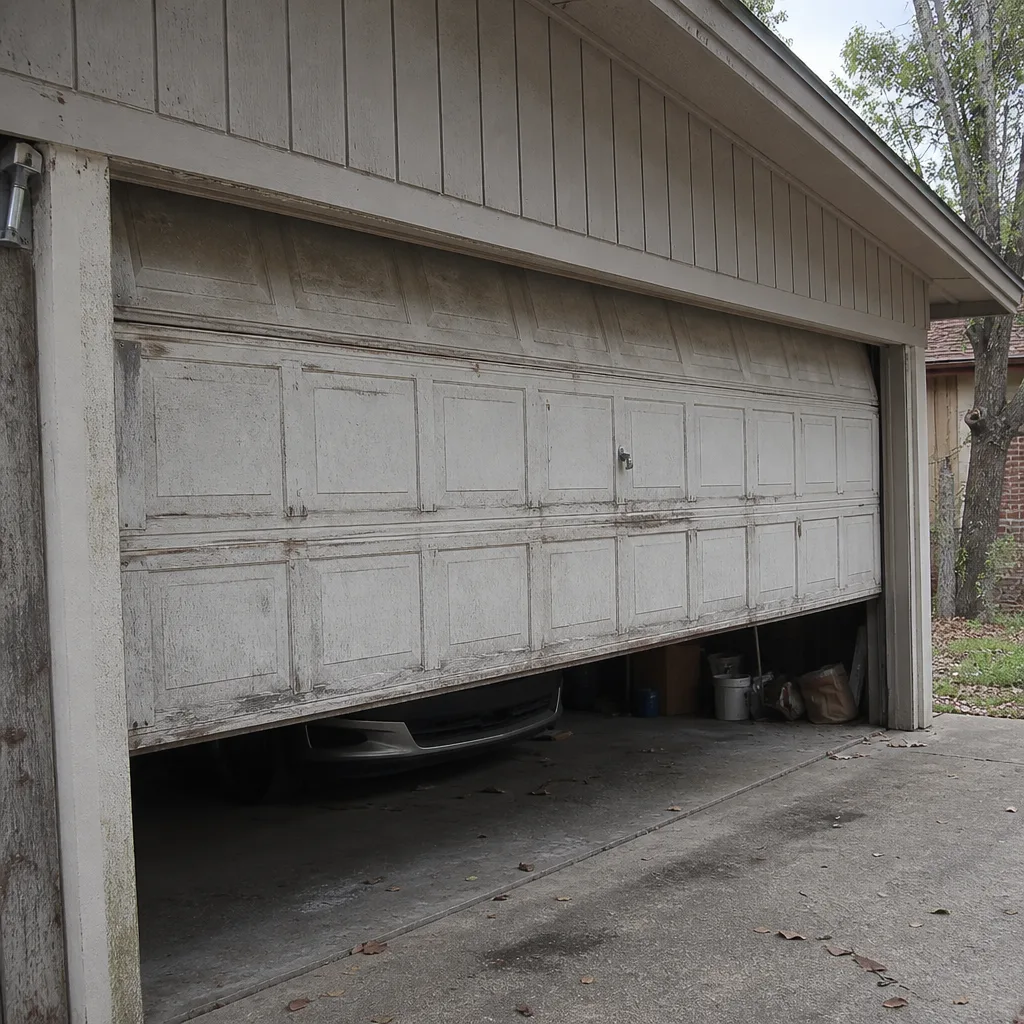 Before
 After
AfterSeasonal Garage Door Care for Spring: Year-Round Homeowner’s Guide
Spring, TX doesn’t have four seasons in the traditional sense. We have a long hot season, a humid shoulder season, and a brief freeze window that arrives without warning. Here’s what surprises most homeowners: those two or three nights of hard freeze each winter cause more garage door failures per event than months of summer heat, because almost no one prepares for them. In this guide, we’ll walk you through how to maintain your door through the three actual cycles our climate creates, what to watch for in each, and how to keep a simple log that turns seasonal checks into real protection for the largest unbraced wall in your home.
Quick Answer
Garage door maintenance in Spring, TX should follow three local climate cycles rather than calendar quarters: summer heat management (May-September), humidity swing checks during shoulder seasons (March-April and October-November), and freeze preparation for brief cold snaps (December-February). A twice-yearly inspection of springs, cables, rollers, and weather seals, combined with proper lubricant selection for our temperature range, prevents most weather-related failures. For a deeper look at each component, see The Complete Guide to Garage Door in Spring.
Table of Contents
- Summer Heat: Thermal Stress on Your Door System
- Shoulder Seasons: The Humidity Swing Window
- Freeze Preparation: The Two-Night Danger
- Hurricane-Season Readiness Without Full Replacement
- Building Your Year-Round Maintenance Log
- The Homeowner’s Seasonal Checklist
- Common Mistakes to Avoid
- When to Call a Professional
- Frequently Asked Questions
Summer Heat: Thermal Stress on Your Door System
From May through September, garage temperatures in Spring routinely climb past 110°F. That heat doesn’t just make the space uncomfortable. It actively degrades several components of your door system, and the damage accumulates slowly enough that most homeowners don’t notice until something fails.
Steel panel expansion is the first effect. A standard 16-foot wide steel door expands roughly 1/8 inch per 10 feet when temperatures swing from morning cool to afternoon peak. Over a full summer, that repeated expansion and contraction loosens hinge bolts, stresses roller brackets, and can throw a door out of alignment. We see this most often in the older neighborhoods north of Louetta, where original doors from the 1980s and 1990s have endured twenty-plus years of this cycle. The door starts to bind in the track, or the opener strains and reverses unexpectedly.
UV degradation of weather seals is the second. The bottom seal and side seals on your door are typically PVC or rubber compounds rated for general outdoor use, not for the sustained UV exposure and ozone levels we get in Harris County summers. After three to four years, these seals harden, crack, and lose their compression memory. A brittle bottom seal no longer conforms to a slightly uneven concrete floor, and conditioned air escapes while dust, pollen, and insects enter. In Spring, where pine pollen season overlaps with the first serious heat, that compromised seal lets yellow dust coat everything in the garage within days.
Opener motor heat load is the third and most expensive. Garage door opener motors are designed with thermal cutoffs that shut them down when internal temperatures exceed safe operating ranges. In an uninsulated garage facing afternoon sun, a motor that normally runs at 140°F can approach 180°F during a July heat wave. The thermal cutoff trips, the door stops mid-cycle, and the homeowner assumes the opener has failed completely. Often, it simply needs to cool. But repeated thermal cycling degrades the motor windings and shortens the unit’s life significantly.
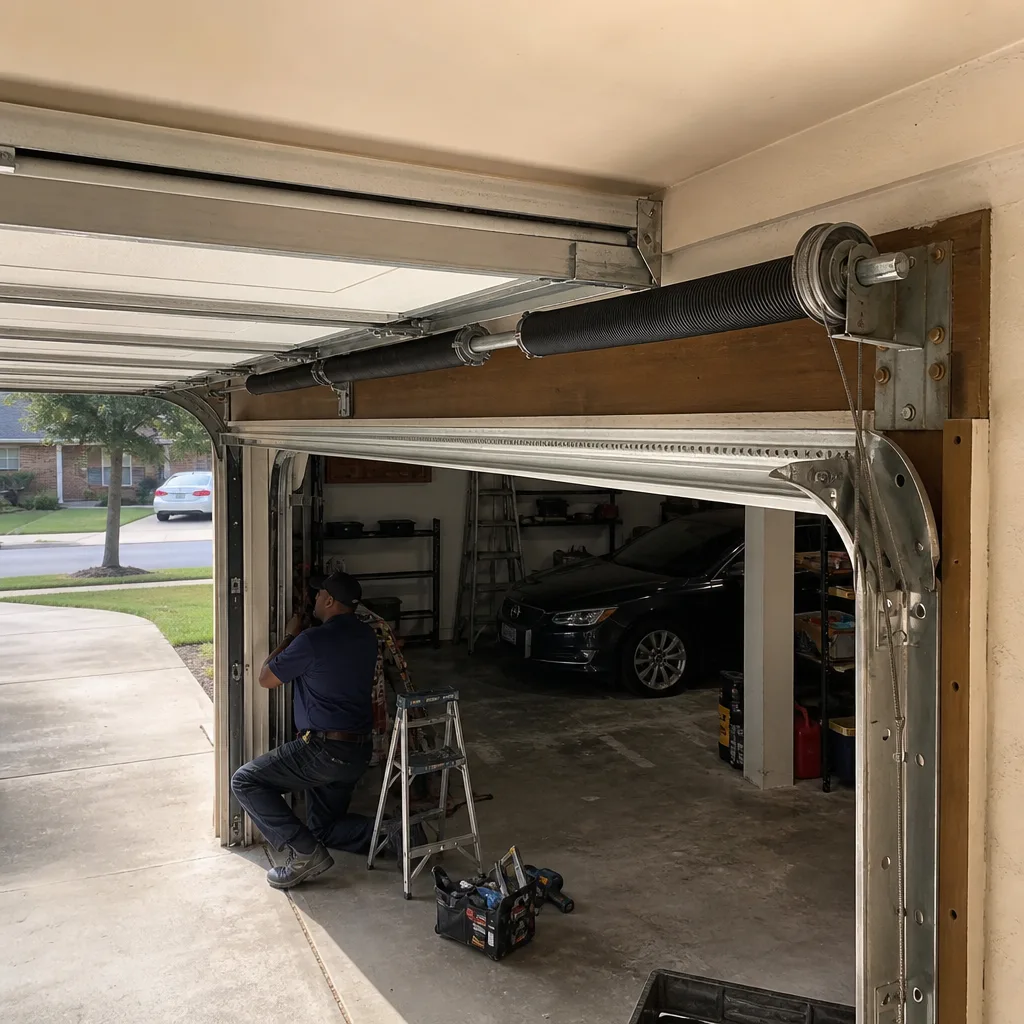
What we do for our customers, and what you can do yourself: check hinge bolts for tightness in late April before the heat arrives, inspect weather seals for flexibility and replace them if they crack when bent, and consider a small ventilation improvement for the garage if your opener motor housing is hot to the touch after normal use. For opener replacement, we install units with higher thermal tolerances, particularly the LiftMaster and Chamberlain models rated for extended temperature ranges.
Shoulder Seasons: The Humidity Swing Window
March through April and October through November are the most misunderstood months for garage door care in Spring. The temperature is moderate, so homeowners relax. But the humidity swings dramatically, sometimes 40 points in a single day, and that moisture movement affects doors more than heat does.
Wood composite doors are especially vulnerable. Many homes in the Gleannloch Farms and Windrose areas have Clopay or Amarr wood-composite carriage doors installed in the early 2000s. These doors use MDF or engineered wood cores with fiberglass or steel skins. When humidity spikes, the core absorbs moisture and swells. When it drops, the core dries and contracts. After enough cycles, the skin delaminates, the panel warps, or the door binds in the frame. We’ve replaced doors that looked fine in March and were visibly bowed by June, with the homeowner never understanding what happened.
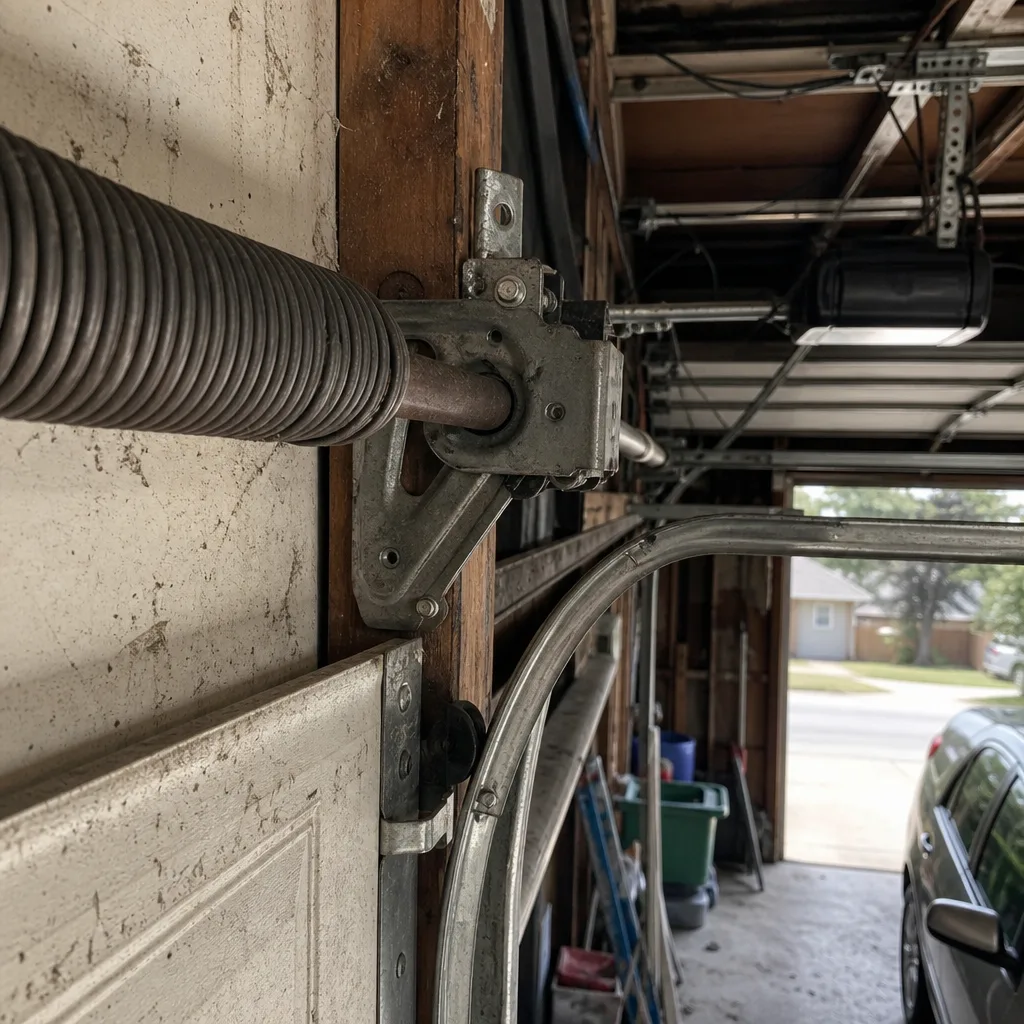
Steel hardware corrosion accelerates during these months too. The humidity condenses on cold steel parts overnight, particularly on the torsion spring assembly and the bottom fixtures where road salt and lawn chemicals may have accumulated. Surface rust forms, pitting begins, and the spring’s cycle life drops. A torsion spring rated for 10,000 cycles might fail at 7,000 if corrosion has weakened the wire.
Electronic sensor drift is a subtler issue. The safety sensors at the bottom of your door track use infrared beams that can scatter off moisture particles in humid air. A sensor that aligned perfectly in January may show intermittent obstruction errors in April. The homeowner adjusts the opener force settings to compensate, which is exactly the wrong response and creates a safety hazard.
Our shoulder-season protocol: inspect wood-composite doors for panel flatness and seal integrity, check all steel hardware for surface rust and treat or replace as needed, and verify sensor alignment with a physical measurement rather than just observing the indicator lights. The Garage Door Repair in Spring page details what we include in our seasonal inspection.
Freeze Preparation: The Two-Night Danger
Spring averages fifteen to twenty nights below freezing each year, concentrated in January and early February. Most are brief, just a few hours before dawn. But every three to five years, a hard freeze arrives with temperatures in the low teens and stays for two or three nights. Those events cause a predictable spike in our emergency call volume, and nearly every call is preventable.
Lubricant thickening is the primary failure mode. Standard garage door lubricants, including the white lithium grease many homeowners apply, are rated for use down to about 20°F. At 15°F, they turn to a thick paste. The door opener motor, already working harder in cold weather, cannot overcome the resistance. The opener gear strips, the trolley separates, or the motor burns out. The homeowner discovers the failure at 6 a.m. when they need to leave for work, and the door won’t move.
Frozen bottom seal is the second. When rain or melted snow pools at the garage threshold and temperatures drop overnight, the rubber seal freezes to the concrete. The homeowner hits the opener button, the motor engages, and either the seal tears away from the door or the opener mechanism fails trying to break the bond. We’ve seen doors with the entire bottom retainer strip ripped out.
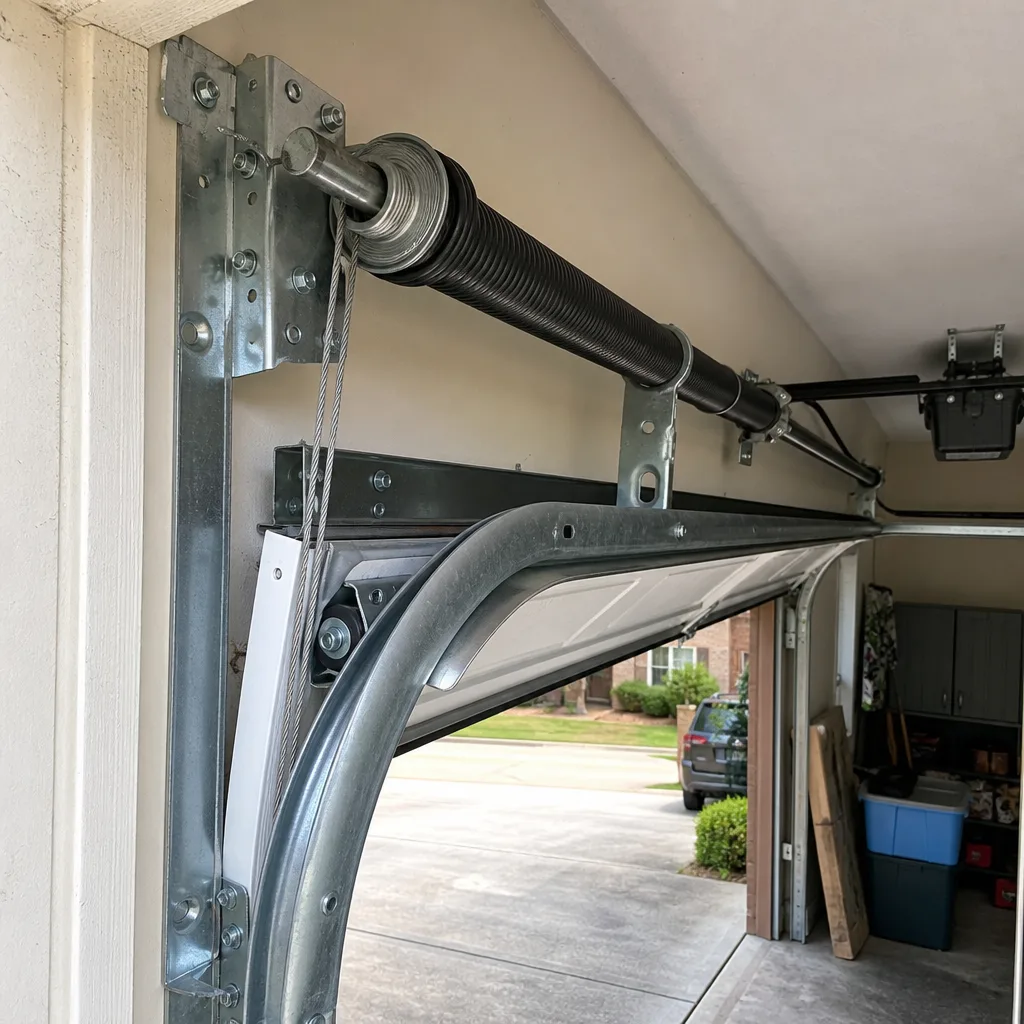
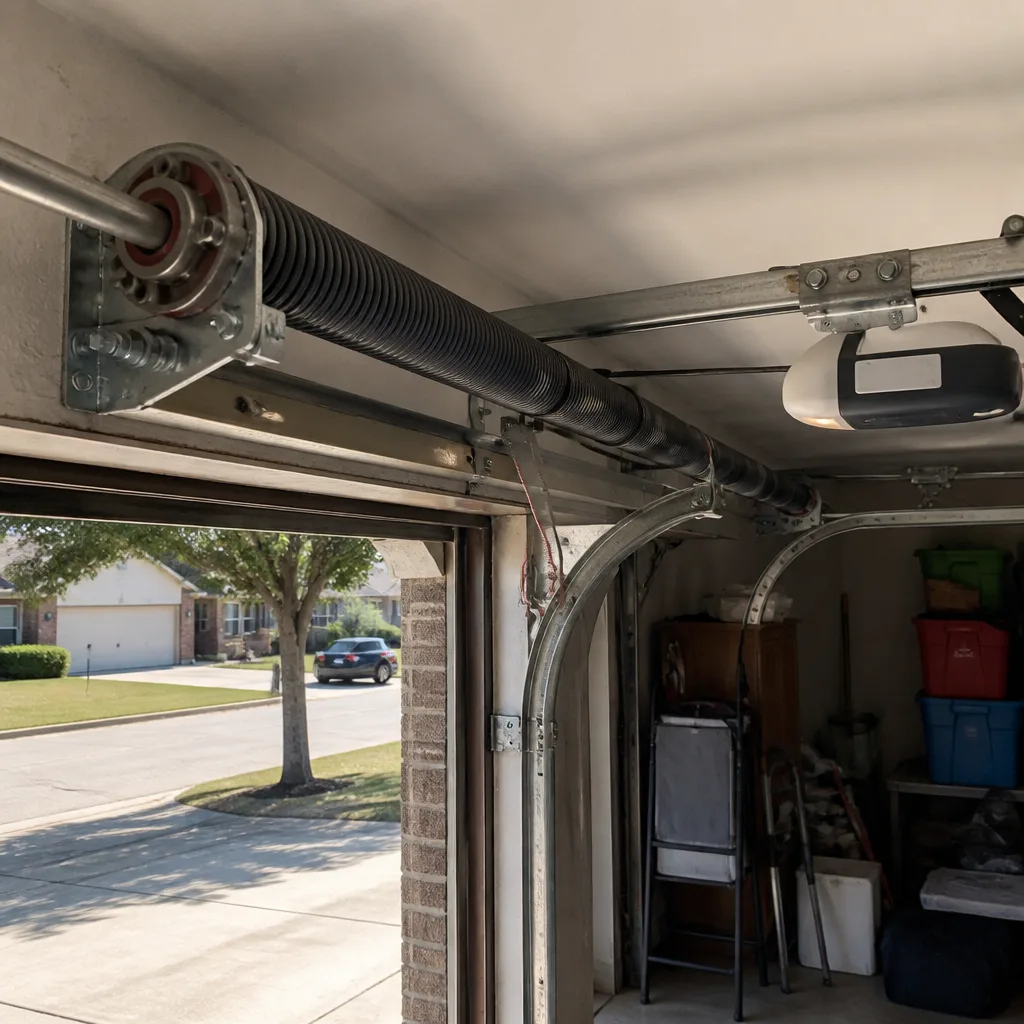
Torsion spring brittleness is the most dangerous. Cold-tempered steel becomes less ductile as temperature drops. A spring with a minor fatigue crack that flexes safely at 70°F can snap catastrophically at 25°F. When a torsion spring breaks, it releases its full torque in an instant. The sound is like a gunshot. The door falls closed, often crooked in the tracks. And the broken spring, if the containment system fails, can cause serious injury.
We do not recommend homeowners service torsion springs themselves. The stored energy is lethal, and the winding process requires specialized tools and training. Our technicians are trained under our K.E.Y.S. values code, and every spring replacement is backed by our 90-Day Done Right Promise.
What you can do before a freeze: switch to a synthetic lubricant rated to 0°F or below, verify your bottom seal is in good condition and the threshold drains properly, and if freezing rain is forecast, place a thin strip of cardboard or plastic sheeting between the seal and concrete before bedtime. The small effort prevents the morning emergency.
Hurricane-Season Readiness Without Full Replacement
Spring sits thirty miles inland, but Hurricane Harvey in 2017 and Tropical Storm Imelda in 2019 demonstrated that inland flooding and wind damage are real risks here. A garage door is the largest opening in most homes, and if it fails in high wind, the pressure differential can lift the roof or push out walls. Full wind-load-rated door replacement is expensive, often $3,000 to $5,000. But there are meaningful intermediate steps that improve survivability without that investment.
Vertical reinforcement is the most cost-effective. Many standard garage doors, particularly the thinner 24- or 25-gauge steel models common in subdivisions built before 2005, can be strengthened with horizontal struts or vertical reinforcement posts. These are steel angles or tubes that bolt to the interior of the door panels and transfer wind load to the track and jambs. A proper reinforcement kit, installed by a technician who understands load paths, can raise a door’s wind resistance from 70 mph to 90 mph or more. That difference matters: many of our local building codes reference 90 mph as the design threshold.
Track and jamb anchoring is often overlooked. The weak point in many installations is not the door itself but the fasteners holding the track to the wood jambs. Over years of vibration, lag bolts loosen. In wind, the track pulls away, and the door departs the opening. A seasonal check of track fasteners, with replacement of any that are loose or corroded, is simple and effective.
Opener disconnect preparedness matters too. If power fails during a storm, you need to operate the door manually. Many homeowners have never used the red emergency release cord, or don’t know that it requires a firm pull straight down, not an angle. Test it once a year. If the door is too heavy to lift manually, your spring system may need adjustment. A properly balanced door weighs roughly 10 to 15 pounds at the handle.
For homeowners considering full replacement, we evaluate whether the existing frame and header can accept a wind-load-rated door, or whether the opening needs structural modification. The Garage Door Installation in Spring page covers our process for that assessment.
Building Your Year-Round Maintenance Log
The most effective maintenance program we’ve seen from homeowners is not the most elaborate. It’s the most consistent. A simple log, kept in the garage or on a phone, transforms seasonal checks from vague memory into actionable data. When you call us with a problem, the log lets us diagnose patterns rather than just today’s symptom.
Here’s what to record, and when:
- Date and weather conditions for each inspection. Note temperature range and any recent humidity swing or freeze event.
- Door balance test result. Disconnect the opener and lift the door manually to waist height. Does it stay, drift down, or rise? Record the behavior.
- Visual inspection findings. Note any rust spots, seal condition, panel damage, or track misalignment. A phone photo with date stamp is sufficient.
- Lubrication date and product used. This prevents over-lubrication, which attracts dust and grit, and ensures you’re using the right product for the season.
- Opener behavior observations. Any unusual sounds, delayed starts, or reversal events. Note time of day and temperature.
- Professional service dates and findings. Keep invoices or summaries. If a technician notes “spring showing wear,” record the estimated remaining life and check against it next season.
After three years, this log reveals patterns that no single inspection can. Maybe your door always drifts out of balance after the first humid week in October. Maybe the opener struggles only on afternoons when garage temperature exceeds 115°F. Maybe the bottom seal degrades faster on the side that gets morning sun. These patterns guide targeted maintenance and prevent the emergency call.
We provide a printed log template to customers who schedule our $89 Seasonal Tune-Up. The technician reviews it with you and notes any items needing attention before the next season.
The Homeowner’s Seasonal Checklist
This checklist organizes tasks by our three actual seasons. Complete it in April, late September, and mid-December for best results.
Summer Preparation (Late April)
- Tighten all hinge bolts and roller bracket fasteners with a socket wrench. Do not overtighten; snug is sufficient.
- Inspect weather seals for flexibility. Bend a corner of the bottom seal 90 degrees. If it cracks or does not spring back, replace it.
- Clean photoelectric sensors with a dry cloth. Verify alignment: the LED indicators on both units should glow steady, not flicker.
- Test opener thermal behavior. Run the door through three complete cycles and touch the motor housing. Uncomfortably warm is normal; too hot to touch for more than a second suggests inadequate ventilation or approaching motor failure.
- Lubricate rollers, hinges, and bearings with a synthetic garage door lubricant. Wipe excess. Do not lubricate the track itself; the rollers need friction to roll rather than slide.
Shoulder Season Check (Late September)
- Inspect wood-composite or wood doors for panel warping, delamination, or finish failure. Run your hand across the surface to feel irregularities your eye might miss.
- Check all steel hardware for rust. Surface discoloration can be cleaned and protected with a light oil. Active pitting or flaking requires replacement.
- Verify door balance. Disconnect opener, lift to waist height. The door should remain within 6 inches of that position. If it drifts significantly, spring tension needs adjustment by a professional.
- Test emergency release. Pull the red handle straight down. The trolley should disengage smoothly. Re-engage by running the opener to the closed position and listening for the click.
- Inspect track mounting. Wiggle the vertical track near the top. Any movement indicates loose fasteners that need tightening.
Freeze Preparation (Mid-December)
- Switch to low-temperature lubricant if you have not already. Verify the product label specifies performance to 0°F or below.
- Inspect threshold drainage. Water should not pool at the garage entrance. Clear debris from any drainage channel or grate.
- Test heater or insulation if present. A minimally heated garage, even to 40°F, prevents most freeze-related failures.
- Verify manual operation capability. All household members should know how to use the emergency release.
- Schedule professional inspection if the door is over fifteen years old or if any spring, cable, or roller shows wear. Cold weather exposes marginal components.
Common Mistakes to Avoid
- Using WD-40 as a garage door lubricant. WD-40 is a water displacement formula and solvent, not a lubricant. It cleans, then evaporates, leaving metal-on-metal contact. Use a product specifically formulated for garage door mechanisms.
- Ignoring the brief freeze because “it never gets that cold here.” Spring’s hard freezes are infrequent but predictable in their effects. The homeowners who prepare for them never make the emergency call.
- Adjusting opener force settings to compensate for mechanical problems. If the door reverses or strains, the cause is usually track misalignment, spring fatigue, or binding hardware. Increasing force masks the problem and creates a safety hazard.
- Replacing only one spring on a two-spring system. Springs on the same door age similarly. A new spring paired with an old one creates imbalance, strains the opener, and often fails within months. We replace both, with matched cycle ratings.
- Neglecting the log between professional visits. Memory is unreliable for intermittent issues. The door that “sometimes” makes a noise is telling you something specific. Record when, and the pattern becomes clear.
- Assuming all garage door technicians are equivalent. In Spring, we’ve corrected work from installers who used wrong spring lengths, improper cable drums, or non-rated hardware. Ask about training, warranty terms, and whether the company will still be around to honor them. We’ve been here since 1984.
When to Call a Professional
Some maintenance is appropriate for a careful homeowner. Some work requires training, tools, and an understanding of the forces involved. Call a professional if you observe any of the following: a broken or frayed cable, a torsion spring with visible gap or rust, a door that has come out of the tracks, an opener that hums but does not move the door, or any sudden change in balance or operation after a weather event.
These conditions involve stored energy or structural load that can cause serious injury without proper handling. Our technicians arrive with springs, cables, rollers, and openers on the truck, so most jobs are completed in a single visit. We state the flat price before any work begins, and every completed job is covered by our 90-Day Done Right Promise in writing.
Mainspring Garage Door Co. offers free estimates in Spring. Call (936) 280-5668 to schedule, or to discuss whether your door is due for seasonal service.
Frequently Asked Questions
Once a year is sufficient for most doors in our climate, with a homeowner inspection at the opposite season. Doors over fifteen years old, or those with heavy daily use, benefit from twice-yearly professional service. Our $89 Seasonal Tune-Up covers all moving parts, balance verification, safety system testing, and a written condition report. Call (936) 280-5668 to schedule.
Use a synthetic garage door lubricant rated for -40°F to 300°F. Standard lithium greases thicken below 20°F and fail during our brief hard freezes. Silicone-based synthetics maintain consistent viscosity across our full temperature range. Apply sparingly to rollers, hinges, and bearings; wipe excess to prevent dust accumulation.
The motor thermal cutoff is engaging. In an uninsulated garage facing afternoon sun, internal motor temperatures can exceed safe operating limits. Improve garage ventilation, add reflective window film if the garage has windows, or consider an opener with higher thermal tolerance. If the problem persists, the motor may be approaching end of life. We can evaluate whether repair or replacement is the more economical path.
We do not recommend it. Torsion springs store enough energy to cause serious injury or death if mishandled. The winding process requires specialized tools and training in load containment. Our background-checked, uniformed technicians handle spring replacement with the proper equipment, and every installation is backed by our 90-Day Done Right Promise. The cost of professional service is modest compared to the risk.
Check three things: the door’s wind-load rating (stamped on a label inside the door or track), the condition of track-to-jamb fasteners, and whether the door has vertical reinforcement. If your home was built before 2005 and the door has never been replaced, it likely lacks adequate wind rating for our current code standards. We can assess whether reinforcement or replacement is appropriate for your exposure and budget.
Do not force the opener. Disconnect it using the emergency release, then pour warm (not boiling) water along the threshold to melt the ice bond. Chip carefully with a plastic tool, not metal, to avoid seal damage. Once free, dry the threshold thoroughly and inspect the seal for tears. For prevention, place a barrier between seal and concrete before forecast freezes, or maintain minimal garage heat. If the opener strained significantly before you stopped it, schedule inspection for gear or trolley damage.
The Bottom Line
Garage door maintenance in Spring, TX works best when matched to our actual climate, not a generic four-season calendar. Summer heat degrades seals and stresses openers. Humidity swings in spring and fall warp composite doors and corrode hardware. Brief winter freezes, though rare, cause concentrated damage because few homeowners prepare for them. A twice-yearly inspection using the checklist above, a simple maintenance log, and timely professional service when wear appears will keep your door reliable through all three cycles. Browse more guides & resources on our blog. The cost of prevention is always less than the emergency call, and the peace of a door that simply works, season after season, is worth the small effort.
Written by Carl Dutton, Owner at Mainspring Garage Door Co., serving Spring since 2016.